
10 March 2026
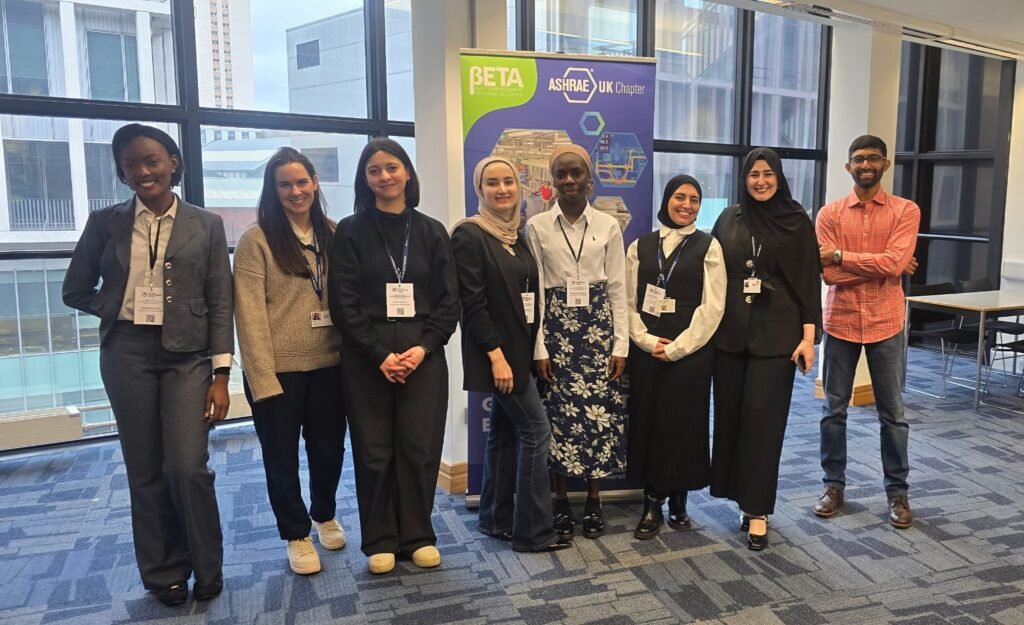
The University of Strathclyde ASHRAE Student Branch, in collaboration with the Strathclyde Centre for Doctoral Training in Energy-Efficient Indoor Climate Control for Optimised Health (EICCOH), hosted a research seminar focused on indoor environmental quality, housing, and health across the life course.
The event brought together PhD researchers, academics, and industry professionals to share ongoing work, exchange ideas, and strengthen interdisciplinary collaboration across indoor air quality, occupant behaviour, housing data, and building performance.
The seminar provided a platform for both established experts and early-stage researchers to present their work in an informal and engaging setting, encouraging discussion and knowledge exchange across sectors.
Seminar Structure and Contributions
The programme was organised into thematic sessions covering indoor air quality, housing and health data, and energy efficiency in real buildings.
Indoor Air Quality and Occupant Behaviour
- Stephanie Onyia (University of Strathclyde)
Translating Evidence into Action: Designing Sustainable and Tailored Indoor Air Quality Interventions for Vulnerable Groups - Danny Kane (Nooku)
Empowering Families to Create Healthier Homes
Danny Kane presented applied work on translating indoor air quality data into practical behavioural insights for households. The session highlighted how engaging families and children can support meaningful, long-term improvements in indoor environmental conditions.
Housing and Health Data Across the Life Course
- Temiloluwa Owolabi (University of Strathclyde)
Leveraging Large-Scale Longitudinal Environmental Data to Reconceptualise Ventilation and Hygrothermal Risk Dynamics - Dr Tim Wilding (University of Edinburgh)
Homes, Heat, and Healthy Kids – Early Childhood Respiratory Infections in the Lothians
The presentation outlined ongoing work linking healthcare, housing, environmental, and socioeconomic datasets to investigate respiratory health outcomes in early childhood.
Following these presentations, a short comfort break allowed participants to continue discussions informally.
Quick-Fire Student Presentations
A rapid presentation session provided PhD researchers with the opportunity to share emerging work across a range of topics, including occupant behaviour, building simulation, retrofit performance, and health impacts of housing:
- Praveen Sirimanne – The potential of natural language processing (NLP) in understanding and analysing occupant behaviour
- Abdalrahman Alajmi – From detailed simulation to fast predictive models: Cooling and comfort during power cuts in Kuwaiti homes
- Rowan McClure (Jemma Fawcett, Elia Guidi) – Feasibility of methodologies to investigate climate-related effects on sleep and mental health in students living in student accommodation in Glasgow
- Leena Shwashreh – The Comfort Paradox of Net-Zero Retrofits: Investigating the breakdown of smart heating acceptance in domestic buildings
- Eleanor Harrison – Which retrofits work best where? How a home’s contextual factors impact the relationship between retrofit and child health
Energy Efficiency, Comfort and Real Buildings
- Dr Carolina Recart (University of Strathclyde)
Beyond Efficiency: Integrating occupant physiology and behaviour into building energy performance assessment - Nour Hallas (University of Strathclyde)
Innovative energy-efficient vertical farming models for wheat production in Algeria’s arid climate - Dr Kevin Browne-MacLeod (Zircon Smart Buildings)
We’re Skint – Can’t Care… Won’t Care
This industry presentation highlighted the financial and institutional barriers affecting indoor air quality improvements in public sector housing, and explored how proactive cost-saving strategies may support healthier indoor environments.
Networking and Engagement
The seminar concluded with closing remarks followed by a networking session with refreshments, providing further opportunity for discussion and collaboration among participants.
A Collaborative Research Platform
The event demonstrated the value of bringing together academia and industry to address complex challenges in indoor environmental quality, housing, and public health. It also highlighted the importance of interdisciplinary approaches in developing evidence-based solutions that can inform both policy and practice.
The ASHRAE Student Branch at the University of Strathclyde continues to support such initiatives, fostering knowledge exchange and engagement across the built environment sector.